Travel to Switzerland, Liechtenstein, Innsbruck and Bavaria
Day 10 Oberammergau – Neuschwanstein – Fussen – Scheidegg (140 Km.)
(in 47 Km.) Hohenschwangau: We began our visit to Neuschwanstein Castle by approaching the visitor area, where parking lots, restaurants, and ticket counters are located. Upon arrival, we learned that there were no available tickets to visit the interior of the castle, as reservations must be made in advance, particularly during the high season. After confirming this information, we decided to focus our visit on the exterior areas, which include several marked trails and scenic viewpoints. From the base area, we followed the main paved road uphill, a route shared by pedestrians, shuttle buses, and horse-drawn carriages. Along the way, there are several signposts providing information about the history and construction of the castle, as well as details about King Ludwig II’s vision for this unique architectural project. The uphill walk takes approximately 30 minutes and gradually reveals views of the surrounding landscape, including forests, hills, and nearby villages.
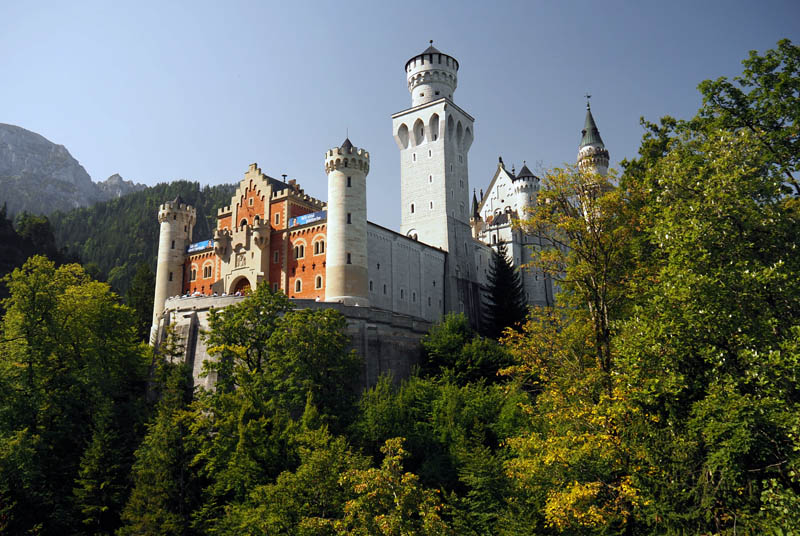
Neuschwanstein Castle
As we ascended further, we reached a series of viewpoints where it is possible to see both Neuschwanstein Castle and the nearby Hohenschwangau Castle, which was Ludwig II’s childhood residence. From these vantage points, Hohenschwangau appears below, surrounded by greenery and located close to Alpsee Lake, whose shoreline is partially visible from the trail. We continued our walk toward the Marienbrücke, a bridge built across a deep gorge, which provides one of the most famous perspectives of Neuschwanstein Castle. The bridge is named after Queen Marie of Bavaria, Ludwig’s mother, and is a popular spot for visitors to take photographs and observe the castle’s architecture from a distance. Access to the bridge is free, but there are safety barriers to manage the flow of people, as it can become crowded during peak hours.
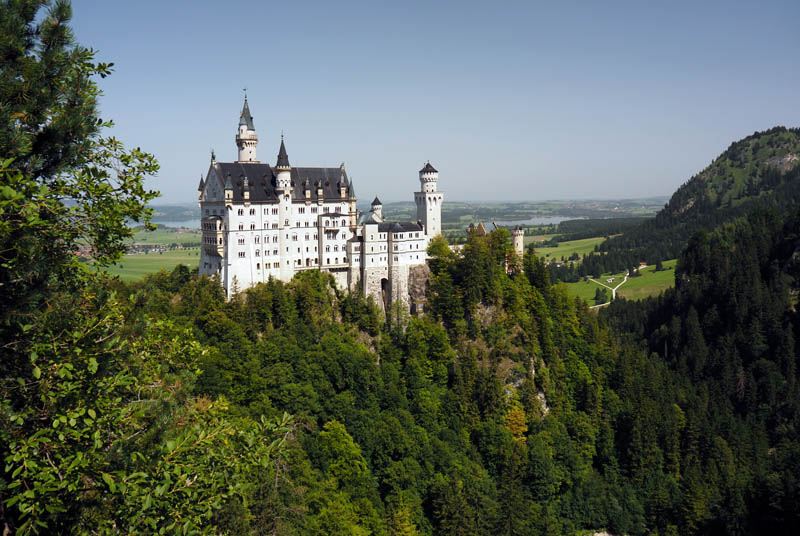
Neuschwanstein Castle
From the Marienbrücke, the view extends beyond the castle itself, revealing the surrounding region. Looking down into the gorge, we could see the river that runs through it, with waterfalls cascading over the rocks below. Turning toward the opposite direction, the landscape opens up to include Alpsee Lake, Schwansee Lake, and the village of Hohenschwangau. This location provides a comprehensive overview of the area’s geography, showing how the castles are positioned in relation to natural features such as lakes, forests, and hills. Informational panels located near the bridge describe the construction of Neuschwanstein, which began in 1869 and was never fully completed due to Ludwig II’s death in 1886. These panels also explain the bridge’s history and its role in providing access to the castle during its construction phase. After spending time at the bridge, we retraced our steps along the path, stopping at several viewpoints to observe the castle from different angles.
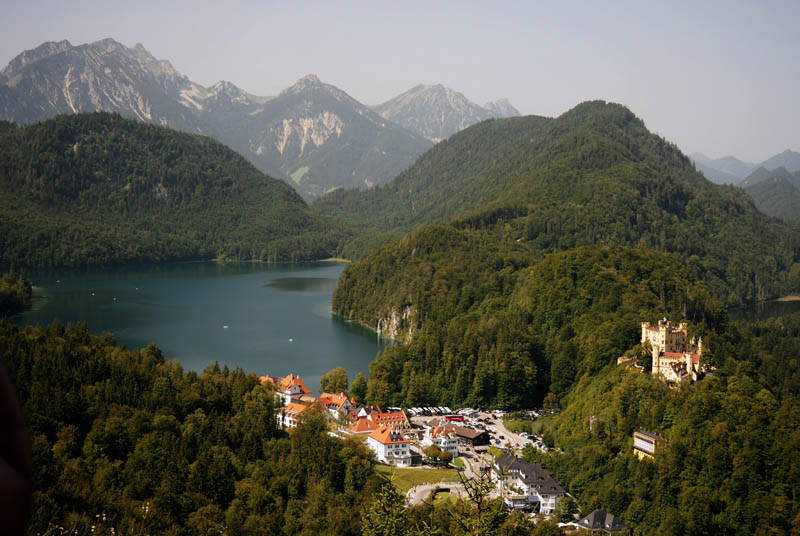
Hohenschwangau Castle and Alpsee
Before descending, we walked around the immediate exterior of Neuschwanstein Castle to view its architectural details up close. The design was heavily influenced by medieval castles, as well as by Ludwig’s fascination with operas by Richard Wagner. The exterior walls feature towers, turrets, and balconies, creating a dramatic silhouette against the landscape. Although visitors are not allowed to enter without tickets, there are several open areas outside where it is possible to study the craftsmanship and layout of the structure. From this position, we also had a clear view of the nearby Hohenschwangau Castle, which is painted in yellow tones and contrasts with Neuschwanstein’s white limestone. After completing the circuit around the exterior, we returned downhill to the base area, concluding our visit to Neuschwanstein by stopping briefly at a viewpoint near Alpsee Lake before heading to the nearby town of Füssen.
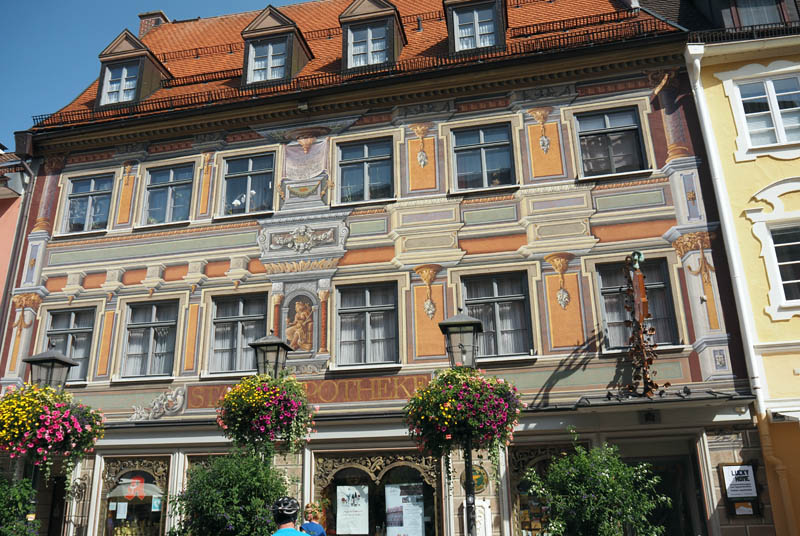
Fussen - Stadt Apotheke
(in 4 Km.) Fussen: Upon arriving in Füssen, we parked near the historic center and began our walking tour along Reichenstrasse, the town’s main street. This pedestrian thoroughfare is lined with buildings featuring colorful facades, many of which house shops, cafés, and restaurants. Along the route, informational plaques describe the historical significance of various structures. One notable stop along the street is the Stadt-Apotheke, a historic pharmacy that has been in operation for centuries. The building’s facade features traditional architectural elements, and its location makes it a recognizable landmark within the town center. As we walked along Reichenstrasse, we observed several side streets leading to small squares and courtyards, which are part of Füssen’s medieval urban layout.
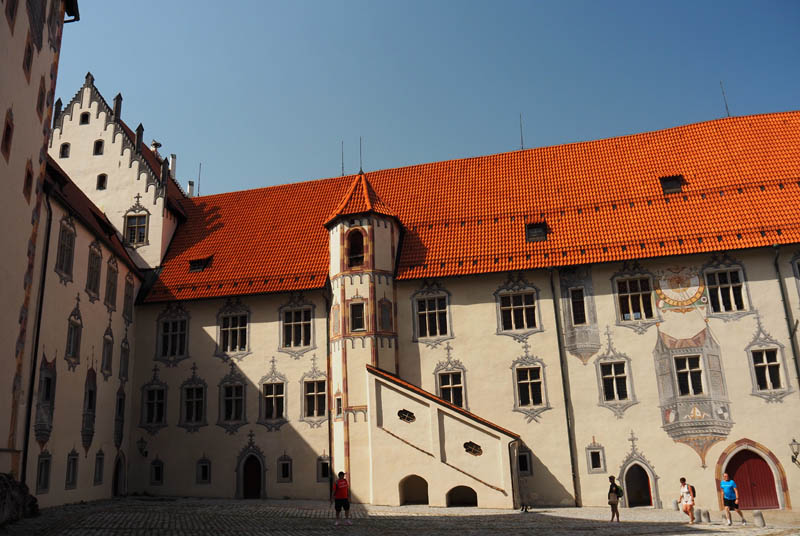
Fussen - High Castle (Hohes Schloss)
From there, we continued to the Benedictine Monastery of St. Mang, a prominent religious complex located near the river. The monastery’s church is known for its baroque architecture, with richly decorated interiors including frescoes and ornate altars. Adjacent to the church, there are additional monastic buildings that now serve different purposes, such as a museum dedicated to local history. After exploring the exterior areas, we proceeded uphill toward the High Castle (Hohes Schloss), a well-preserved fortress that historically served as the residence of the prince-bishops of Augsburg. The castle’s walls and towers provide a commanding view of the surrounding town and countryside. Access is via a steep walkway, and the site includes a courtyard and galleries that display art collections.
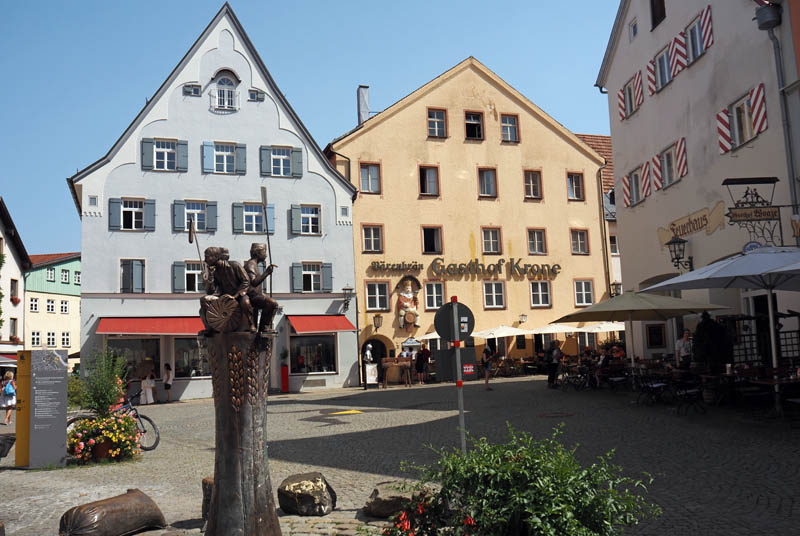
Fussen - Gesellenbrunnen
As we made our way back toward the center, we stopped to see several smaller points of interest, including the Mädchenbrunnen, a decorative fountain featuring a sculptural depiction of a young girl. Nearby stands the Heilig-Geist-Spitalkirche, a church that historically formed part of a hospital complex. This building is notable for its painted ceiling and historical role within the community. Before leaving the center, we paused at a local café to try Schneeballträum, a traditional pastry made of strips of dough rolled into a ball and dusted with powdered sugar or coated with other toppings. This specialty is often associated with Bavarian towns and provides a connection to regional culinary traditions.
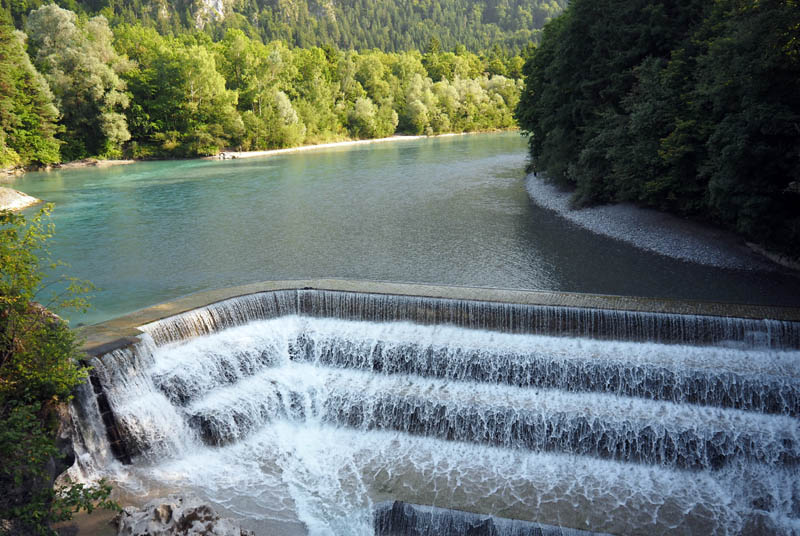
Fussen - Lechfall waterfall
(in 2 Km.) Lechfall: To conclude our visit, we drove a short distance outside the town to see the Lechfall, a waterfall where the Lech River descends over a series of man-made steps. The site is accessible via a pedestrian bridge that crosses above the river, providing clear views of the cascading water below. There are informational signs describing the history of the structure and its role in controlling water flow and preventing flooding. The surrounding area includes walking paths and parking facilities, making it a convenient stop before leaving Füssen. After spending some time at the Lechfall, we returned to our vehicle and prepared for the next stage of our journey, having completed a day that included both the exterior exploration of Neuschwanstein Castle and the historic sites of Füssen.
(in 87 Km.) Scheidegg: We slept in this town.